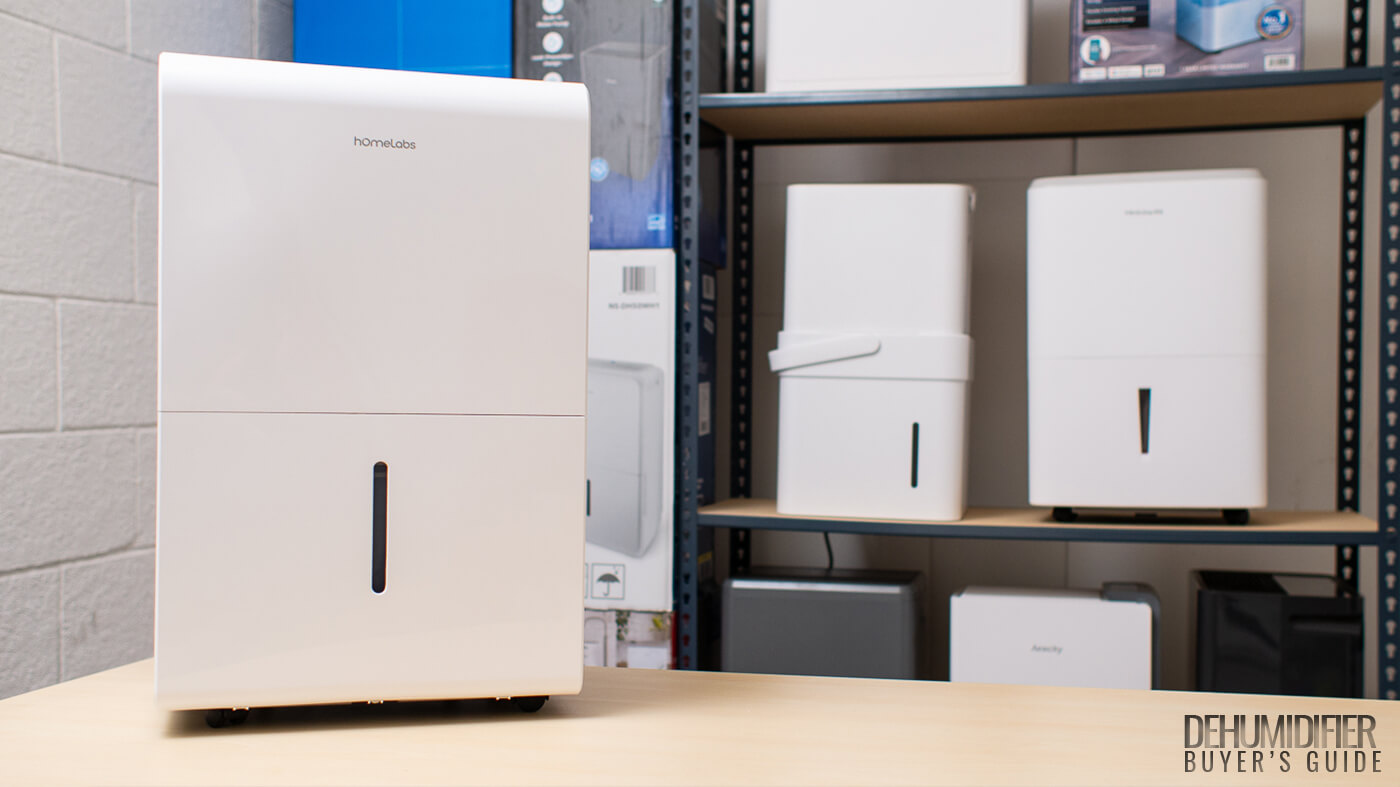
- Below average power draw
- Better than average moisture removal rate according to our testing
- Good hygrometer accuracy
- Not as well built as other top rated competitors
- Small water tank
- Dehumidifier
- Power cord storage bracket (installed on the back of the dehumidifier)
- Instruction Manual

| Energy Efficiency | 4.5 |
| Noise Output | 5.0 |
| Moisture Removal | 4.5 |
| Hygrometer Accuracy | 4.5 |
| Durability | 4.0 |
| Adjustability | 4.5 |
| Versatility | 4.5 |
| Extra Features | 4.5 |
| Ease of Use | 3.0 |
| Portability | 4.5 |
| Warranty | 3.5 |
| Value | 5.0 |
| Editor's Score | 4.5 |
The hOmeLabs 7,000 sq. ft. Dehumidifier (model no. HME1003) is one of the best high capacity (50 pint) dehumidifiers we’ve tested. We cover its performance in our tests and all of its features and functionality in detail in the review below.
Performance Test Results
Energy Efficiency
The manufacturer specifies the HME1003 as having a power draw of 8.5 amps. At 115V this translates to 978 watts.
Note that 978 watts is this unit’s maximum power draw at extreme humidity levels.
In our testing, it was measured to draw 552 watts of power at 50% RH (relative humidity) – at more moderate humidity levels. This is a slightly lower than average result for a full size (50 pint) compressor-based dehumidifier.
Note though that energy efficiency is about more than just power draw. It also depends on moisture removal rate.
And in our testing, the HME1003 removed moisture faster than average (for a 50 pint dehumidifier).
So overall, this model has very good energy efficiency – because it has low power draw combined with a (relatively) high moisture removal rate.
FYI – an extra note on amperage
You can use the manufacturer specified amperage to evaluate how much of a standard 15 amp circuit is going to be “used up” by the HME1003. On any household circuit you don’t want more than 80% of the available amperage being used at any given time. Doing so could cause the associated circuit breaker to trip and/or cause an electrical fire.
As an example, let’s say you have a microwave, a fridge, and a toaster oven on the same 15 amp circuit. You then add a dehumidifier to the circuit. Adding up the amperages of each appliance you wouldn’t want the total power draw to exceed 15 * .8 = 12 amps. If you know the amperages of the microwave, fridge, and toaster oven you can add those right now and subtract that total from 12 amps. If the left-over available amperage is less than 8.5 amps you cannot safely use the HME1003 on the same circuit.
Noise Output
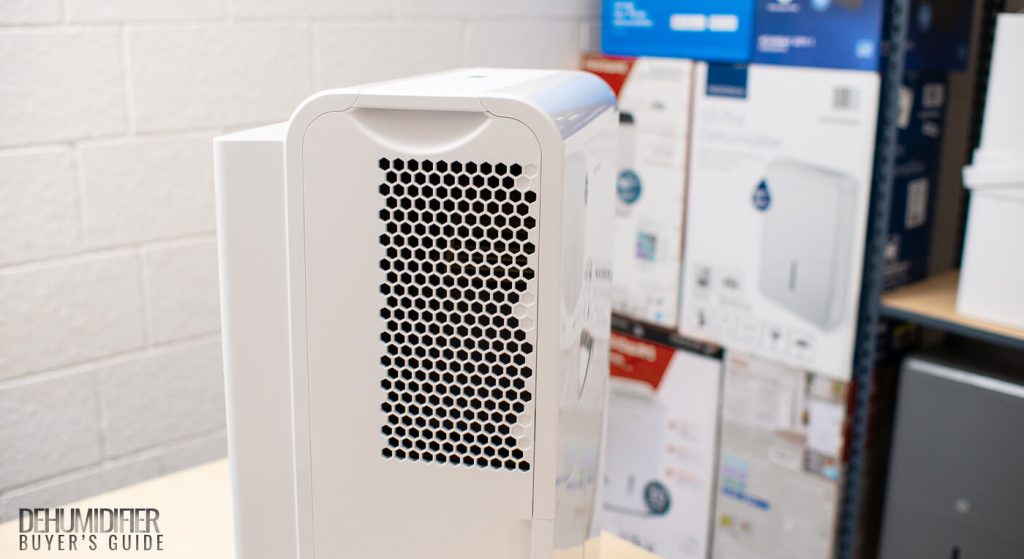
We measure noise output in two different tests. In the first test we place the sound meter right above the dehumidifier’s control panel. In the second test we place it 10 feet away from the dehumidifier. In each test we measure noise output on both high and low fan speed.
For the HME1003…At close distance (above the dehumidifier’s control panel) on high fan speed we recorded 60.7dB on the sound meter. On low fan speed – 58.9 dB. At long range (10 ft.) we recorded 53.6 dB on high fan speed and 51.8 dB on low fan speed.
These readings were all well below average for the 50 pint size class. They are also lower than the readings recorded for the top rated Midea Cube. For example, in the first test (control panel on high fan speed) the hOmeLabs produced 60.7 dB of noise while the Cube produced 66.4 dB of noise. In fact, in all four tests the hOmeLabs unit was measured to produce considerably less noise than the top rated Cube.
However, these statements come with major caveats:
First, the compressor buzzing noise produced by the hOmeLabs was much louder than the same noise produced by the Cube.
Second, the Cube has a much higher CFM fan (430 CFM on high fan speed vs 218 CFM on the hOmeLabs) and an upward facing exhaust that masked its compressor noise much better than the lower CFM fan and side facing exhaust of the hOmeLabs.
The easy comparison to draw here is to a fridge. Refrigerators, like dehumidifiers, use compressors. Have you ever heard an old fridge make a buzzing noise? That’s exactly the noise the hOmeLabs unit makes and, to a lesser extent, that the Cube makes.
While the sound meter shows the hOmeLabs unit producing less dB of noise, our hands on testing of both the HME1003 and the Cube showed the Midea producing a much more pleasant sounding noise. With the Cube, all you hear is fan noise. With the hOmeLabs unit, you still hear fan noise but you also hear a compressor buzzing noise that cuts through the fan noise.
Moisture Removal
The HME1003 performed quite well in our moisture removal tests. In our first test, in which we measure how long it takes the dehumidifier to dehumidify a 50 square foot room from 90% to 40% humidity its time of 9 minutes, 17 seconds puts it in the upper (faster) half of performers in the 50 pint category. The same is true for its performance in the second test, in which we measure how long it takes the unit to dehumidify the same space from 80% down to 50% relative humidity. In this test, it was measured to do so in exactly 5 minutes.
In the first more difficult test (90% to 40%), the HME1003 took about 2 minutes longer than the top rated Cube (7 minutes, 39 seconds). In the second test (80% to 50%) it took only a few seconds longer than the Cube (4 minutes, 48 seconds).
Thus, according to our testing, you can expect the Cube to do much better than the HME1003 in especially challenging (highly humid) conditions. In reasonably non-challenging conditions (mild to low humidity) both units should perform quite similarly.
Hygrometer Accuracy
The HME1003’s built-in hygrometer was tested to read room humidity to within 1 to 2% of the actual room humidity. For example, at 54% RH it would show a reading of 52 to 53% RH.
This matches the performance of that of the top rated Cube which also gave humidity readings that were within 1 to 2% of the actual room humidity.
Included Features, Functionality, Build Quality, Warranties, and Value
Durability (Build Quality)
General Impressions
When it comes to build quality, the HME1003 is a budget grade dehumidifier. At a glance it looks very similar to a higher end unit like the Frigidaire FHDD5034W1 (the best quality “traditional” dehumidifier we tested vs the Cube which has a very “non-traditional” design) but upon closer inspection it becomes quite clear that its built using lesser quality components.
The hOmeLabs unit has three problem areas, in particular:
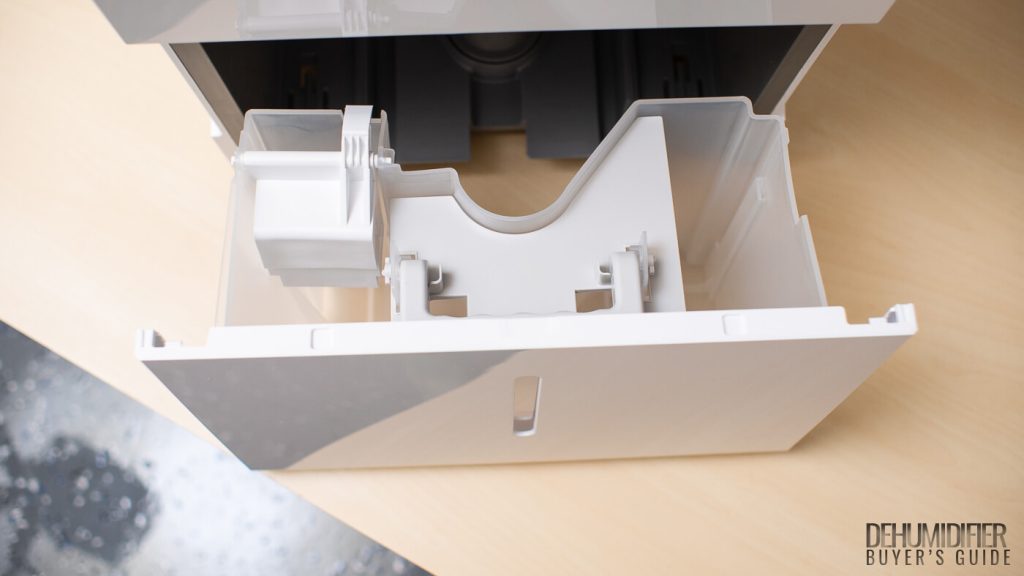
1. Its water tank (see photo below) which in itself has two problem areas: the edges of the tank and the piece that connects the handle to the tank. The edges of the tank are made of an especially thin piece of plastic. We believe these edges can bend, crack, or even break over continual use (when emptying and replacing the water tank). We would also like to see the handle connected to the tank in a more secure manner. The water tank can get quite heavy when filled with water. We believe it’s quite possible for the handle to break off from the tank over continual use as it is currently constructed and attached to the tank.
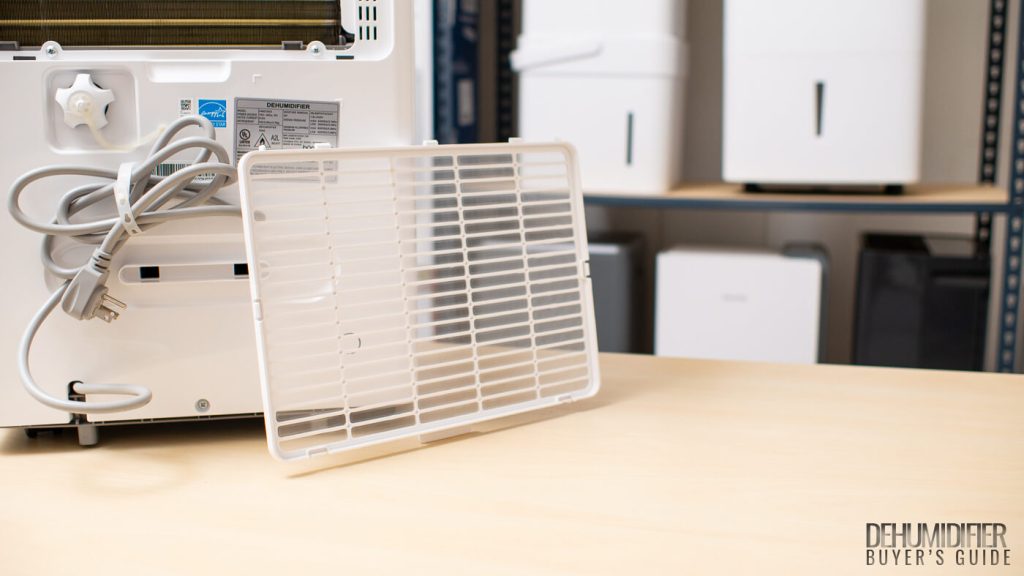
2. The unit’s air filter (see photo below) is glued to an especially thin plastic frame. We believe this frame may be susceptible to cracking and/or breaking over continued use. We also don’t like the fact that the filter is permanently glued to the grille. For comparison, the Frigidaire FHDD5034W1’s filter is a separate part that can be removed from its grille for cleaning.
3. The unit’s control panel appears to be composed of especially low quality parts. The LED display is of a noticeably lower quality than that of many other dehumidifiers we’ve tested.
Consumer Feedback
The HME1003 has thus far seen an overwhelmingly positive response from consumers. The vast majority of user reviews praise its great value (something we agree with), quiet operation (something we do not necessarily agree with), and effectiveness in lowering humidity in a timely manner (something we mostly agree with). According to our most recent survey it has a negative review rate (% of total reviews that are 1 and 2 star reviews) of only about 8%.
There is one important caveat here: in evaluating consumer response to this dehumidifier you have to consider the fact that most consumers only purchase one dehumidifier at a time. We’ve tested over thirty high capacity units alone. Comparing them side by side makes it very clear which dehumidifier is better than the other in which areas. Most consumers don’t have the ability to base their rating off of a comparison of multiple units.
On the flip side of things consumers definitely use these units over a longer period of time than we do. And so consumer feedback, while not the best indicator of overall performance and build quality compared to the competition, is a good indicator of long term reliability.
Overall Category Score
According to our own hands-on testing, the hOmeLabs dehumidifier has a few problem areas when it comes to long term durability and reliability, but it is by no means a poorly built dehumidifier. Furthermore, consumer feedback indicates good reliability with this unit. We rate its durability as being below that of top tier units like the FHDD5034W1 only because the difference in build quality is so stark. Nonetheless, it still receives an above average score in the category: a 4/5.
Adjustability
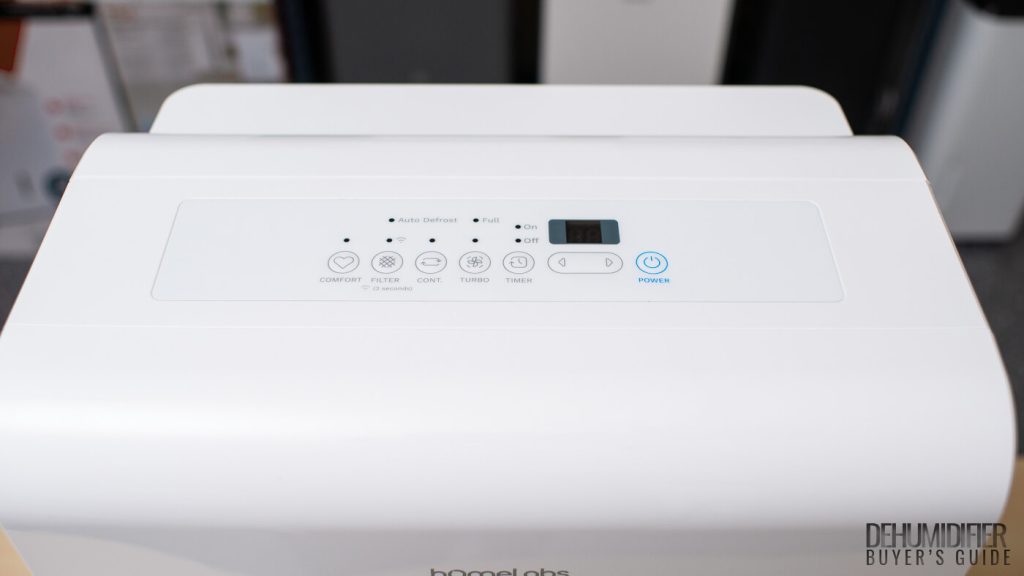
The hOmeLabs HME1003 features standard adjustability for its size class: a humidistat that can be adjusted in 5% increments and a timer that can be set up to 24 hours. You can set the timer when the dehumidifier is off for an auto-start or set it when the dehumidifier is on for an auto-off up to 24 hours.
The HME1003 features two fan speed – normal and turbo. It also features a continuous mode that simply runs the dehumidifier at maximum power continuously.
Overall Category Score
We don’t have much to say in this category. The hOmeLabs HME1003, for the most part, features standard functionality here. It does have one less fan speed, though, than the most adjustable units we’ve tested which reduces its score in the category to 4.5/5.
Versatility
Set Humidity Range
This dehumidifier can be set to a desired humidity level between 35% and 85%. For example, should you set it to 40% and the actual room humidity is 60%, the dehumidifier will run until the room reaches 40% humidity. We have tested 50 pint units that can be set to as low as 30% or as high as 90% but a range of 35% to 85% is perfectly acceptable for the vast majority of applications.
Operating Temperature Range
The manufacturer specifies a minimum operating temp. of 41° F. We couldn’t find any reference (in the user manual or online literature) to a maximum temperature although almost every other compressor based unit we tested is limited to a maximum temperature of 89° to 90° F.
Gravity Drainage
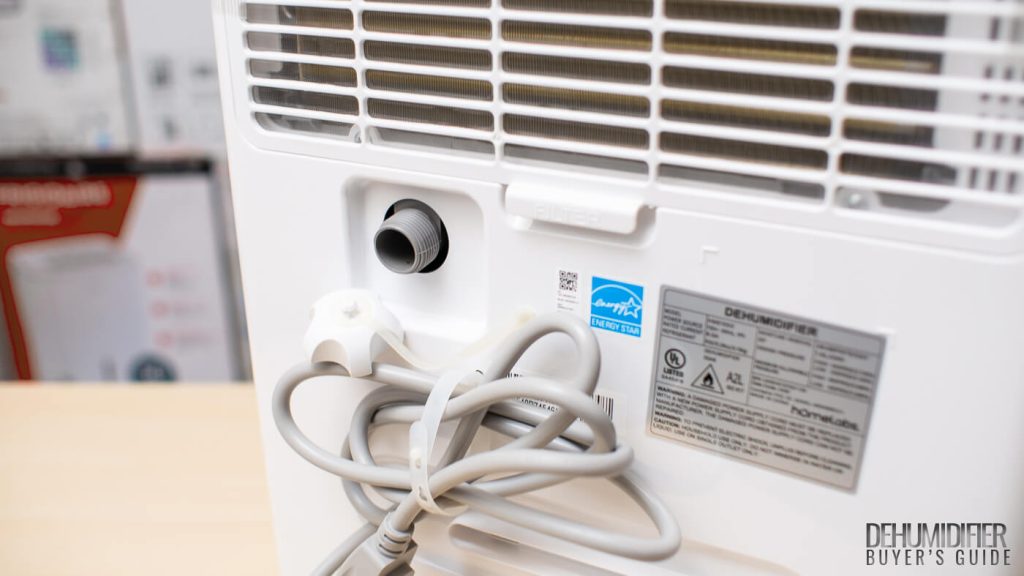
The unit can be drained using a standard garden hose connected to the back of the dehumidifier (photo below shows the drain plug location). Doing so will prevent condensate from collecting in the water tank.
Built-in Pump
This unit does not feature a built-in pump.
Overall Category Score
Again, this hOmeLabs dehumidifier features standard functionality in the category. It has a nearly identical humidity range, operating temperature range, and drainage functionality to that of most high capacity (50 pint) compressor-based competitors. It earns a 4.5/5 in the category.
Extra Features
Temperature Reading
This unit does not display room temperature. Neither does most other compressor based dehumidifiers on the market.
Defrost
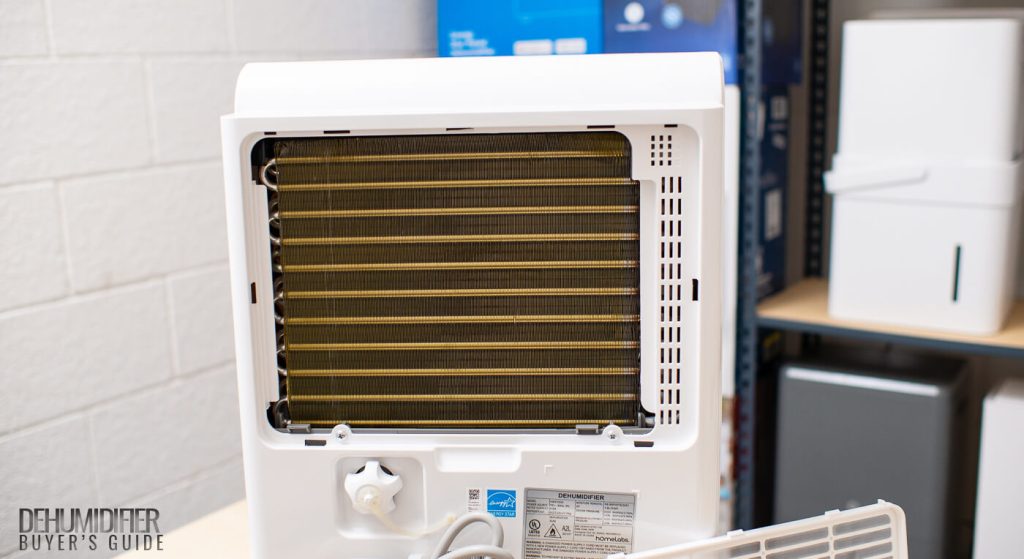
This unit does feature an auto-defrost mode. This mode will activate automatically at lower temperatures if frost builds up on its evaporator coil. The HME1003 also features an indicator light on its control panel to let you know when this mode is activated.
Check Filter
A check filter light will illuminate on the unit’s control panel after several hundred hours of use. This light doesn’t work in conjunction with any sensors. It’s simply a pre-programmed reminder light.
Overall Category Score
The hOmeLabs HME1003 earns a 4.5/5 in the category.
Ease of Use
LED Display Clarity
The HME1003’s control panel looks and feels very similar to that of most other units on the market. Top quality models like the Midea Cube and Frigidaire FHDD5034W1 definitely have a higher quality display though.
Setup Difficulty
This dehumidifier is very easy to setup and program.
Filter Removal Difficulty
The hOmeLabs’ air filter is permanently glued to its grille. You simply remove its grille to clean its filter. With certain competitors like the Frigidaire FHDD5034W1 you still remove the grille to access the air filter, but the filter is a separate part that you unclip from the grille before cleaning it.
Manual Clarity
This dehumidifier has a very well written, well organized, and well-illustrated manual.
Water Tank Size
The HME1003 has a very small water tank with a capacity of only 1.6 gallons or 12.8 pints.
The Frigidaire FHDD5034W1’s water tank, for comparison, has a capacity of 16.9 pints. The top rated Midea Cube’s tank has a capacity of 34 pints!
If you’re draining these dehumidifiers through a garden hose then tank capacity really doesn’t matter – at all.
But, if you’re draining into the dehumidifier’s water tank a smaller tank translates into much more frequent tank emptying and replacement. And anytime the tank fills up, the dehumidifier shuts off, so you generally see more downtime with units with smaller water tanks.
Overall Category Score
Overall, the HME1003 scores only a 3/5 for ease of use, mostly because of its small water tank.
Portability
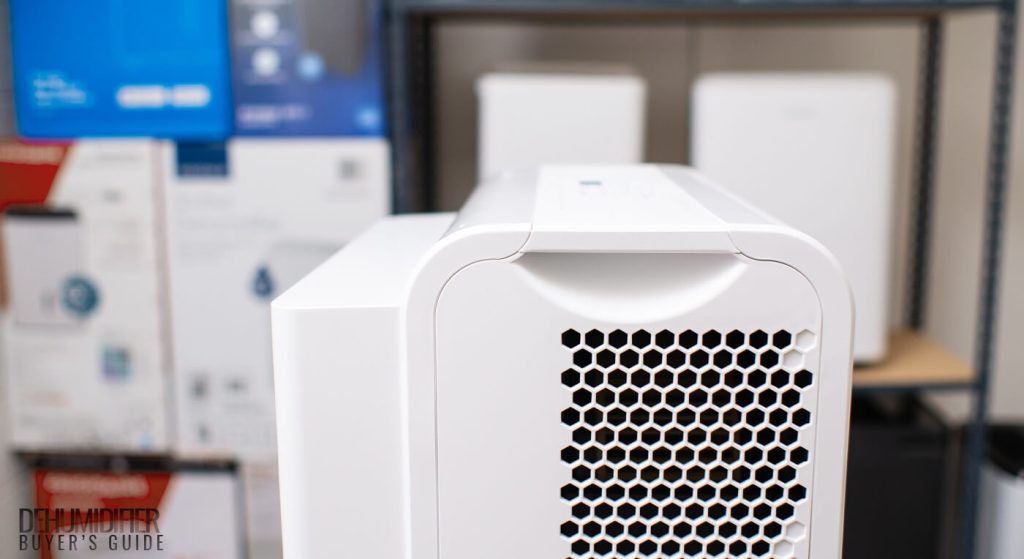
The HME1003 weighs 41.2 lb. The average for this size class (50 pint) is 42.5 lb. which makes this hOmeLabs dehumidifier slightly lighter than average.
This unit also features side pocket handles if you need to pick it up, and it has casters on the bottom (like most competitors) to push it around.
It has a strap on the back and it comes with a plastic bracket that you install on the back of the dehumidifier, around which you can wrap its power cord for storage.
Overall Category Score
Overall, the HME1003 scores 4.5/5 for portability.
Warranty (Manufacturer’s)
This dehumidifier only comes with a 1 year warranty, though that is the standard length warranty for full size (50 pint) compressor based dehumidifiers.
Value
The HME1003 is a good value relative to its features and performance in our tests.

Have a question or comment? Let us know below.