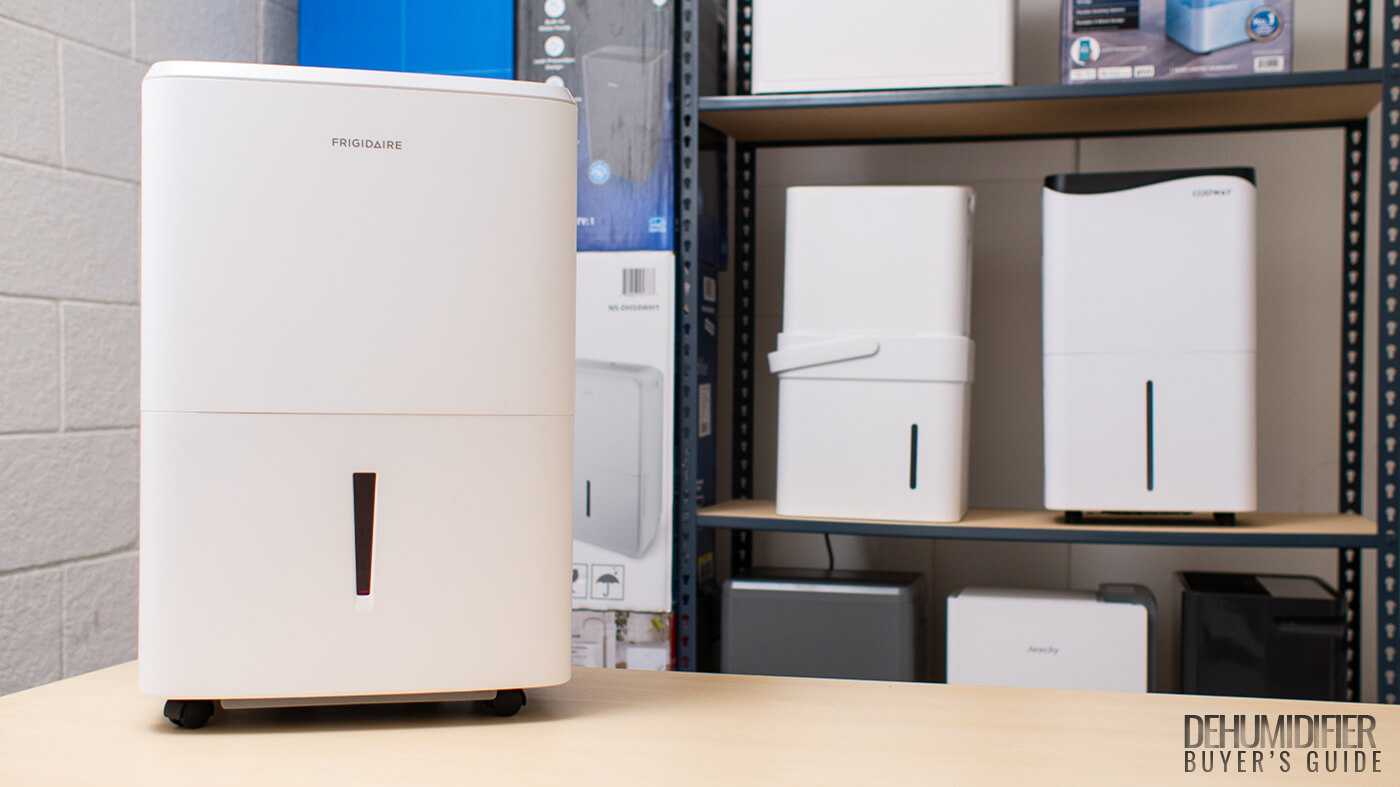
- A top performer in our moisture removal tests
- Excellent energy efficiency
- A pleasing noise output profile due to low compressor noise and an upward facing high CFM exhaust
- Excellent build quality compared to that of most other compressor based dehumidifiers we’ve tested
- Built-in hygrometer doesn’t show reading (of the current room humidity level) on the dehumidifier itself – you can only see this reading through the Frigidaire app
- This dehumidifier only comes with a 1 year warranty
- Dehumidifier
- Instruction Manual

| Energy Efficiency | 4.5 |
| Noise Output | 4.5 |
| Moisture Removal | 5.0 |
| Hygrometer Accuracy | 3.5 |
| Durability | 5.0 |
| Adjustability | 5.0 |
| Versatility | 4.5 |
| Extra Features | 5.0 |
| Ease of Use | 5.0 |
| Portability | 4.5 |
| Warranty | 3.5 |
| Value | 5.0 |
| Editor's Score | 4.7 |
Minor Model Differences
Before we begin the review, we first want to quickly note how there are only minor differences between all of the different 50 pint Frigidaire dehumidifiers on the market.
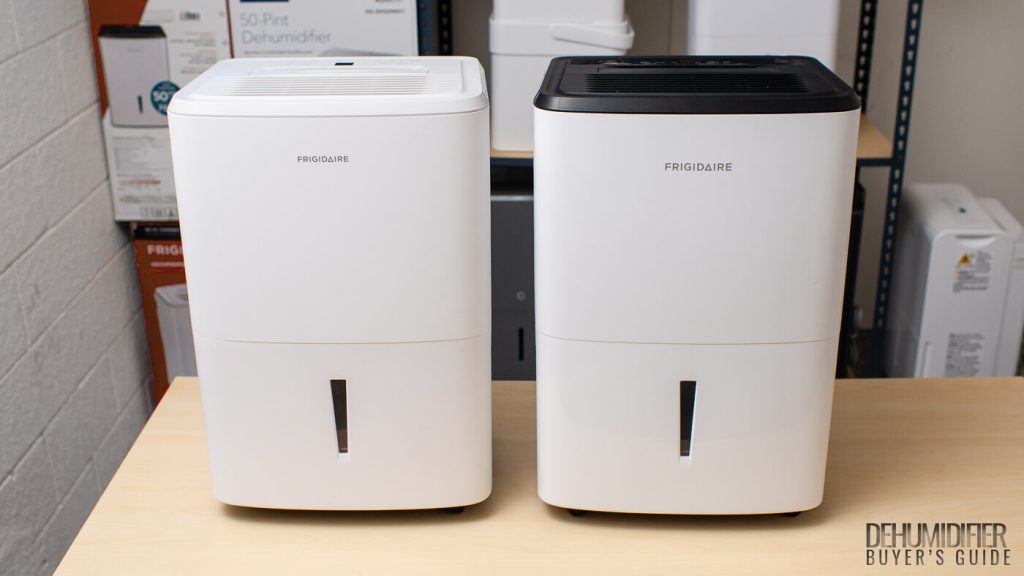
Above (and below) are photos of the FHDD5034W1 vs the FFAD5033W1. The newer model on the left (FHDD5034W1) was released this past year, while the older model on the right (FFAD5033W1) was released in 2019. As you can see there’s very little difference between them despite the fact that they were released six years apart.
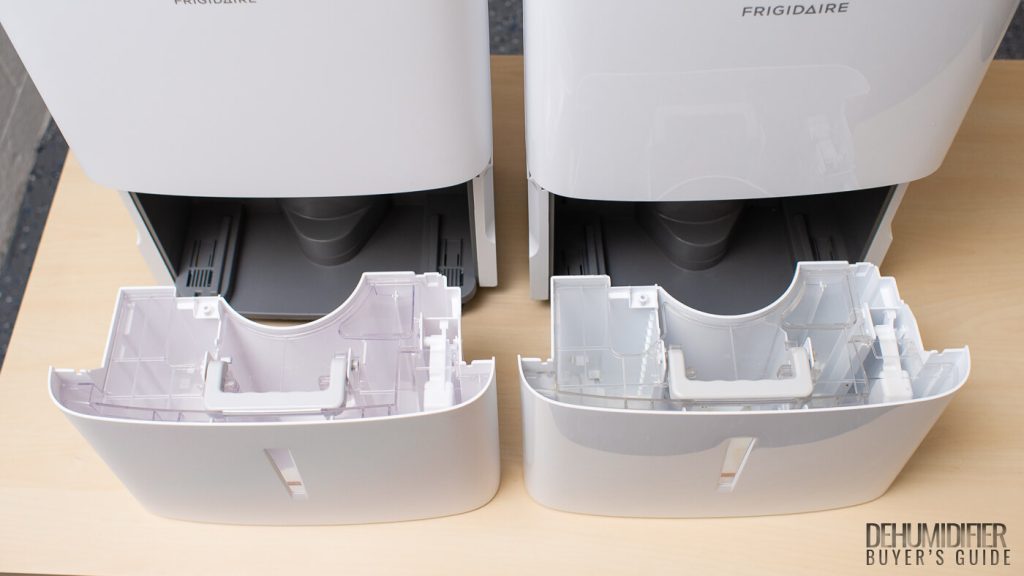
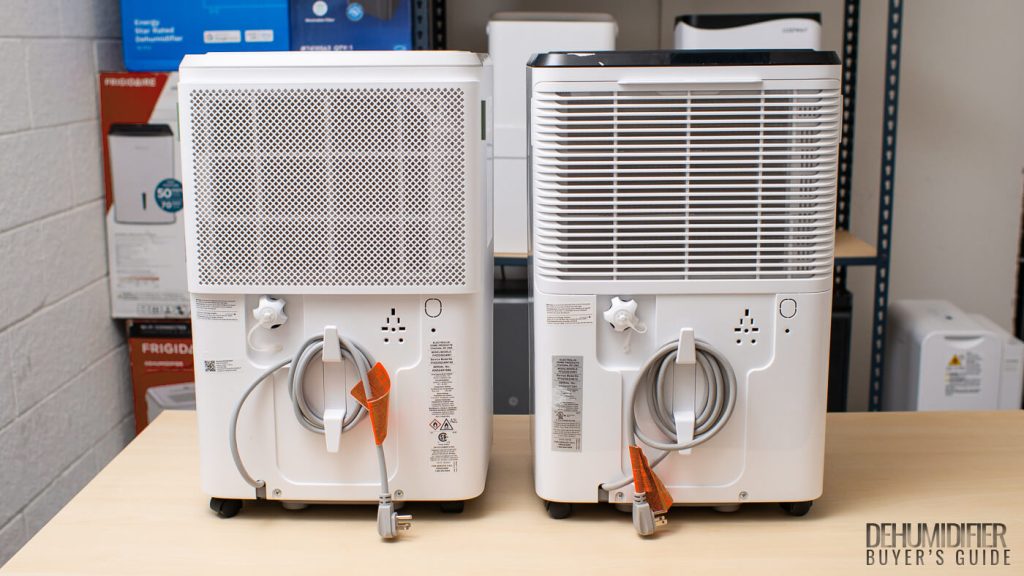
Both of these dehumidifiers also performed very similarly in all of our tests. That is, they have very similar power draw, they have a very similar moisture removal rate, and they make much the same amount of noise according to our testing.
The bottom line – most Frigidaire 50 pint dehumidifiers on the market have a very similar design with very similar performance in our tests. So, if you find a slight variation of the FHDD5034W1 online, this review likely applies just as much to that variation as it does to the FHDD5034W1 itself.
FHDD5034W1 vs FHDD5034Y1
What we just discussed also applies to the FHDD5034W1 vs the FHDD5034Y1.
The W1 (the subject of this review) is specified to draw 8.5 A of power with an IEF (integrated energy factor) of 1.8 L/kWh. The Y1 draws 8.8 A with an IEF of 2.01 (in other words, it draws slightly more power but it runs slightly more efficiently). Otherwise, these two models are all but identical and this review applies just as much to the FHDD5034Y1 as it does to the FHDD5034W1.
If you want to buy either one of these units, we recommend buying whichever model is cheaper at this time.
Check the FHDD5034W1’s current pricing.
Check the FHDD5034Y1’s current pricing.
Performance Test Results
Energy Efficiency
At Extreme Humidity
The FHDD5034W1 has a manufacturer specified power draw of 8.5 amps (978 watts). This falls in the upper end of the range for 50 pint dehumidifiers. The hOmeLabs HME1003 (8.5 amps = 978 watts) and Toshiba TDDP5014RES2 (8.5 amps = 978 watts) are a few other examples of units that fall in the upper end of the range. The GE APHL50LB (7.4 amps = 851 watts) and TCL H50D44W (7.5 amps = 863 watts) are some examples of units that fall in the lower end of the range.
Our own testing revealed all of these units to have a similar power draw of approx. 760 watts at extreme humidity levels (close to 100% RH). This, of course, is less than the 978 watts the FHDD5034W1 is rated for, suggesting that the manufacturer specification either… a. involves running the dehumidifier in even more extreme conditions than what we can emulate in our own “extreme humidity” testing or b. is more of a guideline for safe use. Remember, all manufacturer specifications are given in amps. We calculated the watts listed above by multiplying the given amperage by 115 (volts). It’s not unreasonable to believe manufacturers are giving power draw in amps simply for you to estimate safe use of their appliance on a 15 amp circuit. By erring on the side of caution and specifying a slightly inflated amperage, the manufacturer is allowing for safer use of their appliance.
At Moderate Humidity
We also measured power draw at a more moderate humidity level (right around 50% relative humidity).
In these conditions, we saw two things:
First, we saw a lot more variance in measured wattage between different models. Recall that all of the 50 pint units we tested had approximately the same power draw of 760 watts in our “extreme humidity” testing. In more moderate conditions they did not all have the same power draw.
Second, we found all units to draw much less power at 50% RH (Relative Humidity) than they did at higher humidity levels. This was expected, as a dehumidifier’s power draw is directly proportional to how hard it has to work to dehumidify. At close to 100% RH it has to work a lot harder than at 50% RH.
In our moderate humidity testing the Frigidaire drew only 560 watts of power at 50% RH. The hOmeLabs drew 552 watts and the Toshiba drew 535 watts. Surprisingly, those units with a lower manufacturer specified amperage drew more power at 50% RH. The GE drew 610 watts and the TCL drew 584 watts.
Overall, at more moderate humidity levels, the Frigidaire was measured to have slightly below average power draw compared to all of the other 50 pint dehumidifiers we tested.
Power Draw and Moisture Removal Rate in Determining Energy Efficiency
Dehumidifier energy efficiency not only depends on raw power draw, but it also very much depends on how long it takes the dehumidifier to remove moisture from the air.
If two dehumidifiers have similar power draw (such as what we saw in high humidity testing), the more energy efficient unit is the one that removes moisture faster – the one that draws that power for a shorter period of time.
This is exactly what we see with the Frigidaire. It removed moisture much faster than most other 50 pint dehumidifiers we tested in our moisture removal tests. In other words, it took much less time to dehumidify a high humidity space than most other 50 pint dehumidifiers we tested.
The fact that it was able to remove moisture faster at the same approx. power draw at high humidity, makes it one of the most energy efficient 50 pint units we tested at high humidity.
Since it has low power draw compared to the competition and still removes moisture faster at moderate humidity, it is also the most energy efficient 50 pint unit we tested at more moderate humidity levels.
Energy Efficiency Conclusion
Assessing a dehumidifier’s energy efficiency can be a complex task. To make this assessment we take into account manufacturer specifications, our own power draw test results, and our own moisture removal rate test results. We also consider Energy Star certification. In this case, the Frigidaire FHDD5034W1 is fully Energy Star certified.
When all of this is taken into account we can safely say that the FHDD5034W1 is one of the most energy efficient dehumidifiers on the market.
Noise Output
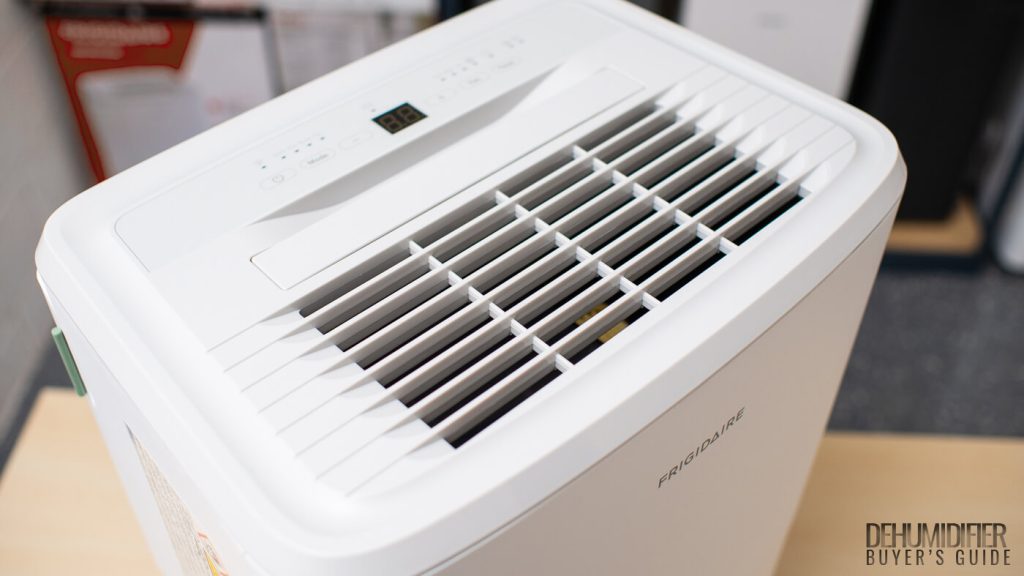
The FHDD5034W1 can get very loud, but this isn’t necessarily a bad thing. Let us explain.
Dehumidifiers primarily make two types of noise:
- Compressor noise
- Air noise generated by air moving through the dehumidifier and out through its exhaust Compressor noise is very unpleasant to listen to. It’s the same buzzing noise you might hear from an old refrigerator.
The second noise – air noise mostly generated by air moving through the unit’s exhaust – is a much more pleasant sounding noise.
We test for raw noise output. This gives us dB numbers that describe the extent of the loudness of a dehumidifier but not the quality of that loudness.
The FHDD5034W1 was one of the louder dehumidifiers we’ve tested. Its tested noise output, measured right next to the dehumidifier’s control panel, was 69.8 dB on high fan speed and 62.7 dB on low fan speed. Measured 10 ft. away from the dehumidifier it was 54.4 dB on high fan speed and 48.2 dB on low fan speed.
For comparison, the very “quiet” hOmeLabs HME1003 garnered the following results in the same tests: 60.7 dB (control panel high fan), 58.9 dB (control panel low fan), 53.6 dB (10 ft. high fan), and 51.8 dB (10 ft. low fan). These are clearly lower raw dB numbers than those of the Frigidaire.
Still, we consider the hOmeLabs the “noisier” dehumidifier.
Why? Because of its noise output profile (i.e. the quality of the noise it produces).
The hOmeLabs has a louder compressor, a lower CFM fan, and it exhausts through its side. This results in lower raw dB numbers but a much more unpleasant noise output profile because the air noise generated by its fan doesn’t completely mask its compressor noise (unless you’re in the direct “line of sight” of its exhaust).
The Frigidaire has a quieter compressor, a higher CFM fan, and it exhausts through the top of the dehumidifier (which allows it to emit fan noise omnidirectionally). All of these factors contribute to allow the FHDD5034W1’s fan noise to completely mask its compressor noise on high fan speed.
The end result is that the Frigidaire has one of the best (the most pleasing sounding) noise output profiles of any high capacity dehumidifier on the market. Is it the quietest from a technical standpoint (by looking at raw dB numbers)? No, it’s not.
But we think you’ll much prefer the sound of this “louder” dehumidifier operating in a room over many of the more “quiet” options out there.
Moisture Removal
Our moisture removal rate tests are perhaps the most important tests we perform. You’re buying a dehumidifier to dehumidify. And the faster it does it the better. These tests show which dehumidifiers can dehumidify the fastest.
In the first test we measure how long it takes the dehumidifier to dehumidify a 50 sq. ft. space from 90% down to 40% relative humidity (RH). In the second test we measure how long it takes to lower room humidity from 80% down to 50% RH.
The FHDD5034W1 performed very well in both tests but it garnered especially good results in the first test. The Frigidaire took only 8 minutes, 32 seconds to lower room humidity from 90% down to 40% RH. This is good for the second best result among the 16 high capacity (50 pint) dehumidifiers we tested recently (that have not been discontinued).
The Frigidaire also performed well in the second test (80% to 50% RH). Among non-discontinued models we’ve tested it placed third behind the GoveeLife H7151 (first place) and Midea Cube (second place). The H7151 had a time of 4 minutes, 45 seconds and the Frigidaire had a time of 4 minutes, 50 seconds (only 5 seconds slower than the fastest model we tested).
Hygrometer Accuracy
The Frigidaire features a built-in hygrometer just like every other compressor-based dehumidifier on the market.
This hygrometer reads the current humidity in the room.
The built-in hygrometer is especially important if you set a specific target humidity level on the dehumidifier.
If you manually set the dehumidifier to a room humidity of, let’s say, 60% for example, the dehumidifier will continue to run until its built-in hygrometer reads 60%. Once it reads 60% the dehumidifier will automatically cycle off. It will then stay off until the built-in hygrometer reads a humidity level above 60%, at which point the dehumidifier will automatically cycle back on.
Now, let’s say the dehumidifier’s built-in hygrometer is off (inaccurate) by 6% – it reads room humidity to be 6% less than the actual humidity. In this case the dehumidifier would read 60% when the actual room humidity is 66% in the scenario described above. Thus, the dehumidifier would shut off well before actual room humidity was at the desired room humidity of 60%.
This is why hygrometer accuracy is important.
When it comes to the FHDD5034W1’s performance in our hygrometer accuracy testing – it measured humidity to within 3% of actual room humidity.
This isn’t a terrible result but it’s not a top tier result either. More accurate models like the TCL H50D44W, for example, were able to consistently give a reading that was within 1% of the actual room humidity.
The bigger problem for the FHDD5034W1, though, when it comes to its built-in hygrometer, is that it doesn’t display its humidity reading on its control panel. You can only see what the dehumidifier is reading as the current room humidity through the Frigidaire app.
This is a big negative for users that don’t want to use the app with the dehumidifier.
Included Features, Functionality, Build Quality, Warranties, and Value
Durability (Build Quality)
General Impressions
The FHDD5034W1 is one of the most well made dehumidifiers we’ve tested. Comparing it side by side within most other 50 pint dehumidifiers it’s clear that the Frigidaire is built using higher quality parts and materials.
The control panel buttons and LEDs are higher quality. The plastics used for the body are higher quality. The plastics used for the water collection bucket are thicker and higher quality. The grille and air filter are two separate higher quality pieces vs the combined grille/air filter we see on most other units. Even the brackets used to wrap the power cord around the back of the unit are higher quality. Almost every component on this Frigidaire is of a tangibly higher quality than the equivalent component on the average dehumidifier.
Consumer Feedback
At the time of us writing this review, this model is relatively new to market. As such there’s really not much to take away – regarding long term durability and reliability at least – from consumer reviews right now.
Overall Category Score
The FHDD5034W1’s build quality is simply a cut above that of most other 50 pint units we’ve tested. For this reason alone it receives a 5/5 in the category.
Adjustability
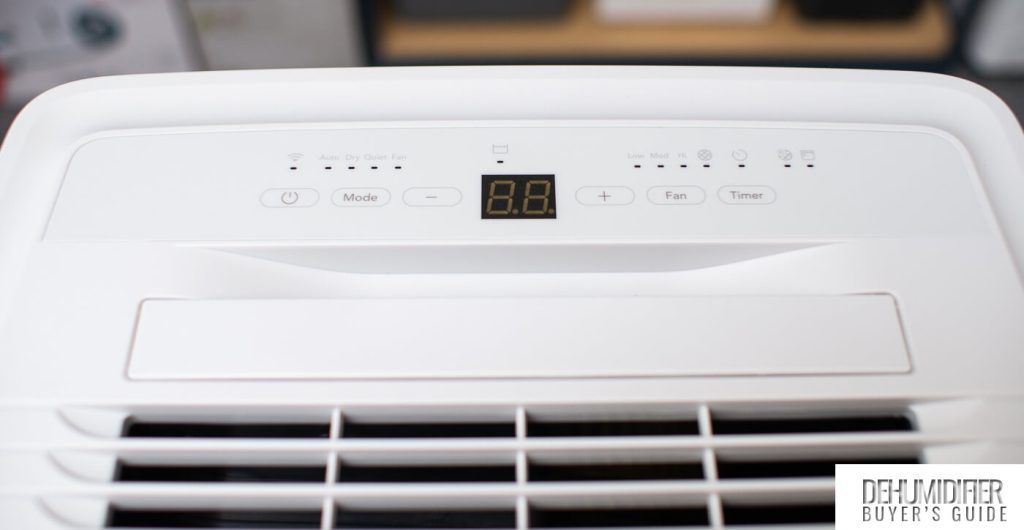
The unit features a timer that can be set in half hour increments up to 10 hours, and 1 hour increments from 11 hours up to 24 hours. Most other timers on most other dehumidifiers feature similar adjustability. Exceptions are units like the GE ADEL45LY that can only be set to 2 hours or 4 hours, and units like the GoveeLife H7151 that can only be set in 1 hour increments all the way from 1 hour up to 24 hours.
The Frigidaire’s humidistat can be manually set in increments of 5%. This, again, is an industry standard. The only exception is the now discontinued Haier DE65EM that let you set a target humidity level in 2% increments.
The FHDD5034W1 features 3 fan speeds. Many other 50 pint dehumidifiers, including the hOmeLabs HME1003 and Keystone KSTAD504F, feature only two fan speeds – normal and turbo. The FHDD5034W1′s extra fan speed isn’t much of an advantage though as you’ll almost always want to run all of these units on only one fan speed – high fan speed – to drown out compressor noise.
Finally, the FHDD5034W1 does feature a continuous mode – again, an industry standard.
Overall Category Score
The FHDD5034W1 earns a 5/5 in the category – it’s just about as adjustable as a large capacity compressor based dehumidifier can be.
Versatility
Set Humidity Range
The FHDD5034W1 can be manually set to a target humidity level between 35 and 85% – again, an industry standard. Some units, like the LG UD501KOG5 and Hisense DH5026KP1G do allow you to set the desired humidity level a little lower – to 30%. Others, like the Honeywell TP70WKN, allow you to set it a little higher – to 90%.
That being said, 35% to 85% should work for the vast majority of applications. If you require a room humidity level lower than 35% RH you can simply set the Frigidaire to continuous mode. It can theoretically dehumidify all the way down to 0% RH if left on this mode.
Operating Temperature Range
Again, it’s par for the course with this Frigidaire. Its manufacturer specified operating temperature is 41° F to 89° F. This is approximately the same range as every other compressor based dehumidifier on the market.
Gravity Drainage
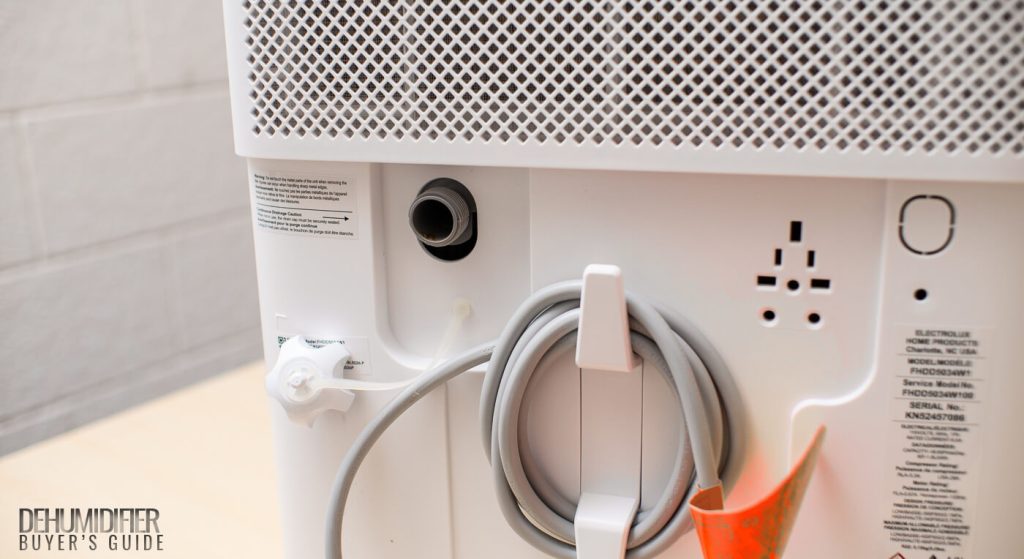
Just like most other 50 pint dehumidifiers on the market, the FHDD5034W1 has a drain outlet (on the back) that allows you to connect a garden hose to employ gravity drainage.
With no hose connected (and with a cap over the drain outlet) the dehumidifier will drain into its water collection bucket. With a drain hose connected, it will automatically drain through the hose.
Note that some 50 pint models (e.g. the Black+Decker BDT50WTB) ship with a gravity drain hose. The FHDD5034W1 does not. It requires that you supply your own garden hose to employ gravity drainage.
Built-in Pump
The FHDD5034W1 does not feature a built-in pump. We generally do not recommend built-in pump dehumidifiers as they tend to fail within a few years of use. Check the consumer reviews of any built-in pump dehumidifier and you’ll see a slew of negative reviews complaining of early pump failure.
If you need to drain to a higher location than the dehumidifier itself (meaning you can’t use gravity drainage) we recommend the use of an external condensate pump. This option adds a bit to the cost of the dehumidifier but we believe it to be a much better option than a built-in pump dehumidifier
Overall Category Score
The Frigidaire earns a 4.5/5 in the category.
Extra Features
Temperature Reading
Back in 2014, when we first started testing dehumidifiers, several models showed the room’s current temperature in addition to its current humidity level. Here we’re talking about models like the now discontinued Danby DDR70A2GP and ArcticAire ADR70A2G.
Most modern units have dropped this functionality. Of the 16 high capacity models we tested recently, none displayed temperature. The only unique display was that of the Honeywell TP70WKN which displays relative humidity (RH) on its front panel in addition to its top control panel.
Defrost
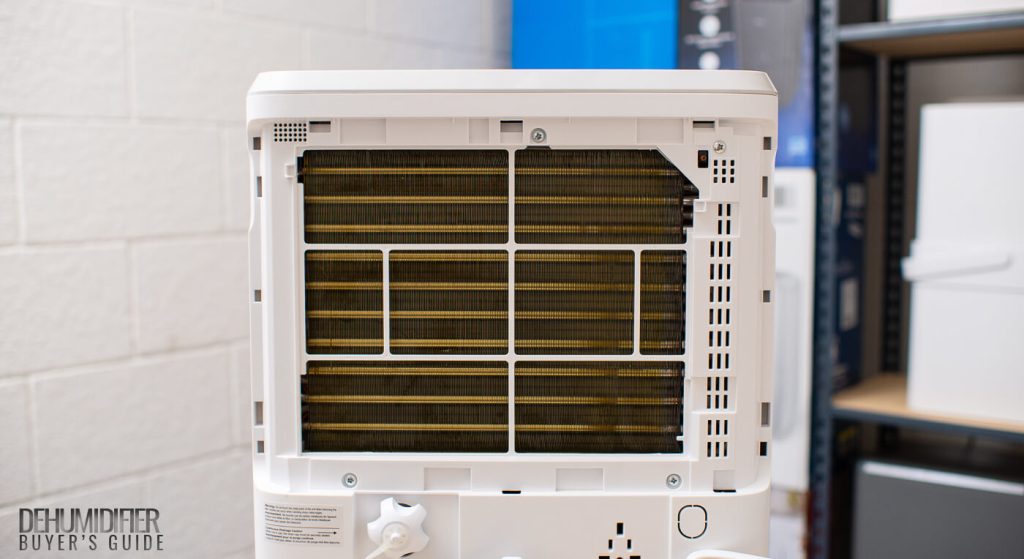
Like most other compressor-based dehumidifiers on the market, the FHDD5034W1 will cycle off its compressor and only run its fan if ice builds up on its evaporator coil (note that this usually only happens at very low temperatures).
When defrost mode (fan only, compressor cycled off) is activated an LED will illuminate on the dehumidifier’s control panel.
Check Filter
An LED will also illuminate to alert you when it’s time to remove and clean this unit’s air filter.
Wi-Fi
The FHDD5034W1 does allow you to control it remotely using the Frigidaire app.
You can set it to different modes, adjust fan speed, monitor the room’s humidity (via the dehumidifier’s built-in hygrometer), and turn the dehumidifier on and off with the app.
Overall Category Score
Overall, the FHDD5034W1 scores a 5/5 for its extra features.
Ease of Use
LED Display Clarity
As was mentioned earlier (in the “durability” section of the review), the FHDD5034W1 does feature a very high quality LED display. Most competitors, including the highly rated hOmeLabs HME1003, have a much lower quality display.
Setup Difficulty
The FHDD5034W1 couldn’t be simpler to use. Every button that needs a label is properly labeled. Every LED indicator light that needs a label is also properly labeled.
Some competitors, like the BDT50WTB, have a control panel with buttons and LEDs that are not adequately labeled. Due to this lack of proper labeling, the average user will absolutely have to reference the Black+Decker’s manual to figure out what certain buttons do and what certain LEDs signify. The Frigidaire’s control panel is properly labeled so that those same users will be able to use it without needing to reference its manual.
Filter Removal Difficulty
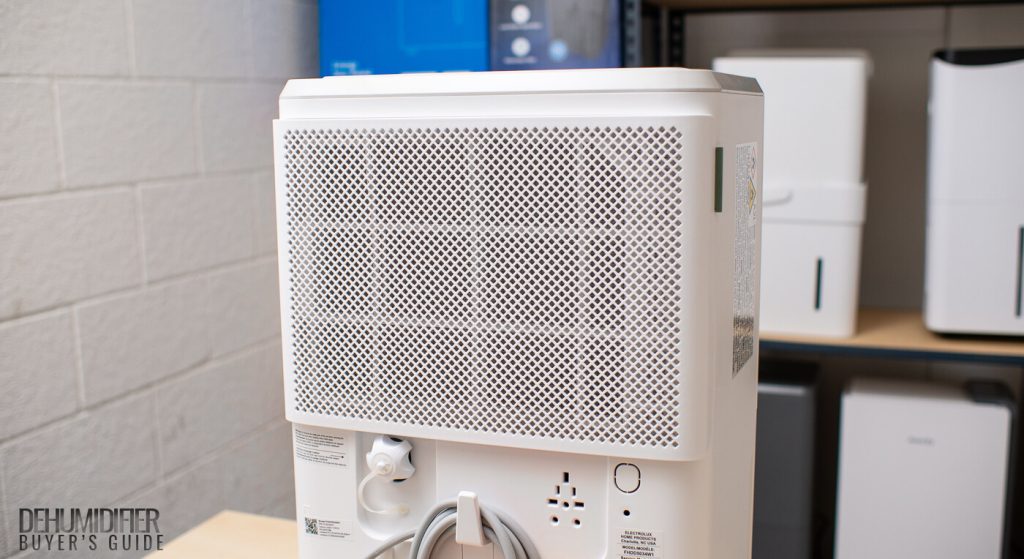
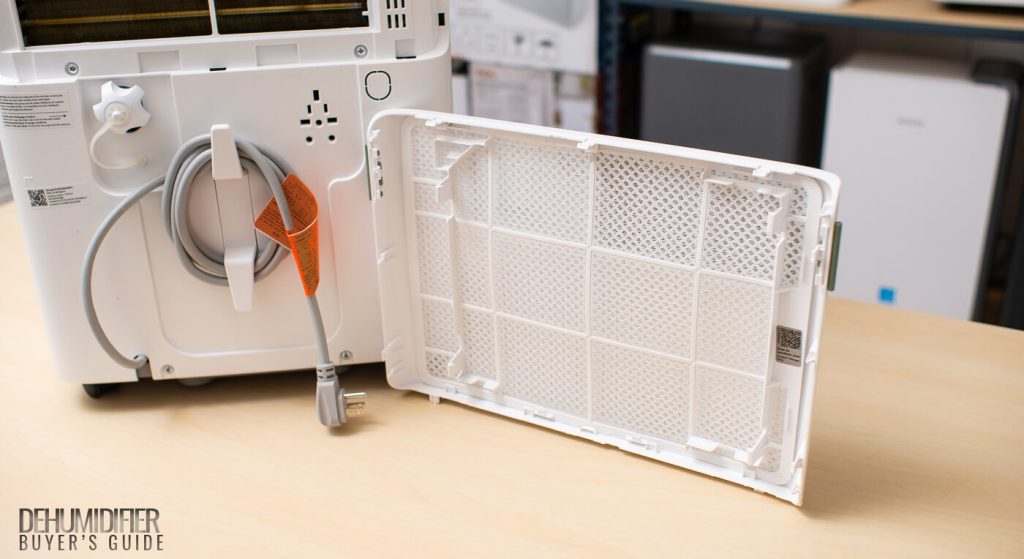
The FHDD5034W1 has a grille on the back. This grille holds a filter that should be cleaned every few weeks. We didn’t have any trouble removing or replacing the air filter during testing.
Manual Clarity
Frigidaire dehumidifier manuals have always been well-written. The same is true for the FHDD5034W1 manual.
Water Tank Size
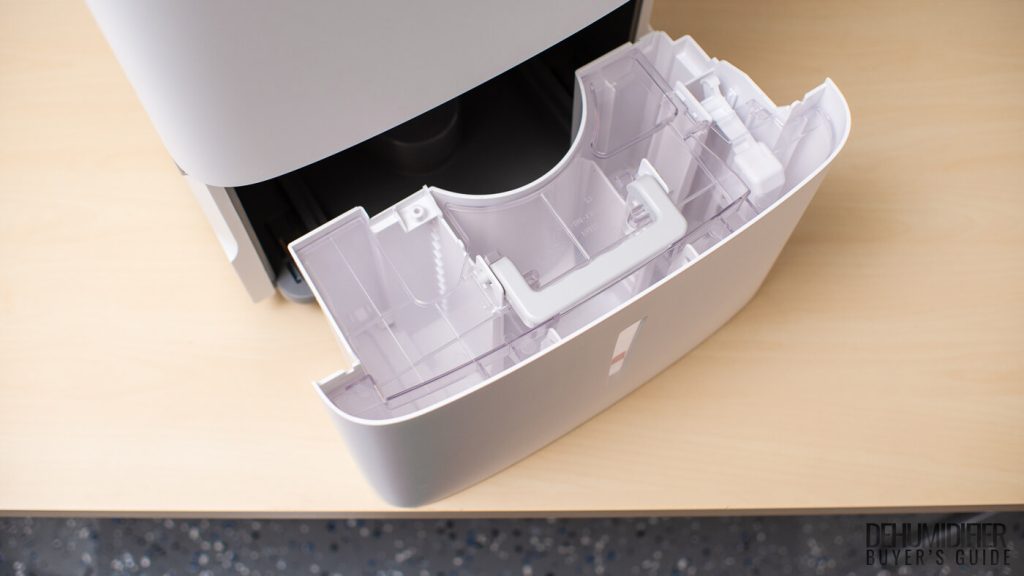
The FHDD5034W1 features a well above average sized water tank. Its capacity is 16.9 pints. Most other 50 pint units we tested have a water tank with a capacity in the 13 to 15 pint range. The tank capacity for the hOmeLabs HME1003, for example, is only 12.8 pints.
Overall Category Score
The Frigidaire FHDD5034W1 is very easy to use and features a very large water tank. It earns a 5/5 in the category.
Portability
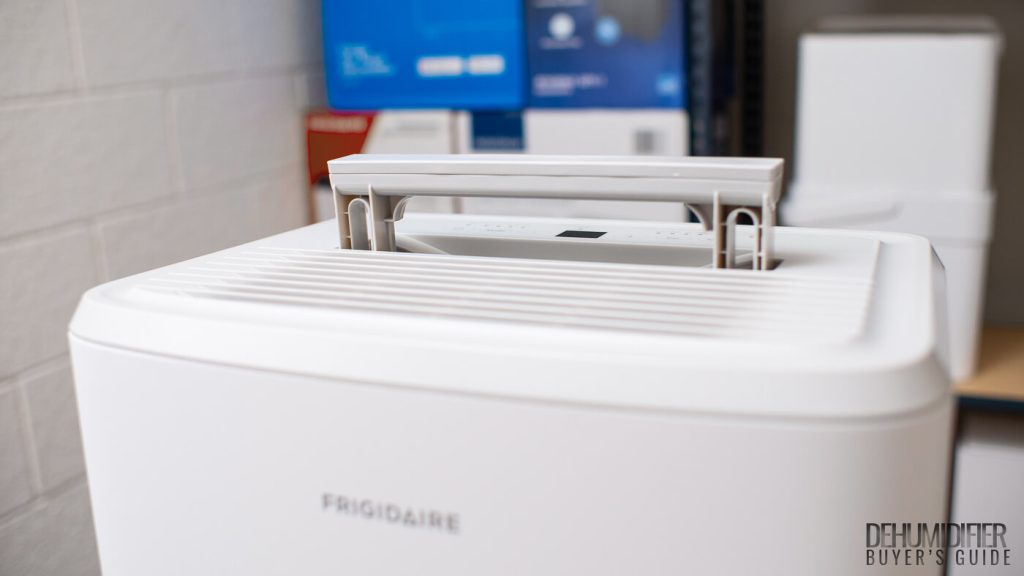
The FHDD5034W1 weighs only 41 lb. The average weight of the 16 most recent 50 pint dehumidifiers we tested is 42.5 lb.
The FHDD5034W1 has a top extendable handle that we much prefer over the side pocket handles of most competitors (like the hOmeLabs HME1003). With a top handle you simply reach down and pull up to lift up and carry the dehumidifier. With side pocket handles you have to bend much lower and grab the dehumidifier awkwardly to lift it up and carry it.
The Frigidaire also features very high quality cord storage. It has two plastic hooks on the back that are part of the main body of the dehumidifier. You can wrap its power cord around these hooks.
Many competitors only have a low quality plastic strap to hold the power cord and some models don’t have any cord storage feature at all.
Overall Category Score
Overall, the Frigidaire earns a 4.5/5 for portability.
Warranty (Manufacturer’s)
The industry standard dehumidifier warranty lasts for only 1 year. The same is true for the warranty included with the Frigidaire FHDD5034W1. This is one of the few negatives for this dehumidifier.
The FHDD5034W1 does feature excellent build quality and should last well over 1 year, 2 years, even 3 years and beyond. But we would have liked to see a longer warranty included – a 2 year warranty at a bare minimum.
Value
As of the writing of this review, the Frigidaire FHDD5034W1 has an average to above average price for a 50 pint dehumidifier. That being said, you do “get what you pay for” with this dehumidifier.
Final Thoughts
The Frigidaire FHDD5034W1 is the second best 50 pint dehumidifier we’ve tested. It comes highly recommended if the Midea Cube is out of stock or if you’re looking for a dehumidifier with a more traditional design.

Have a question or comment? Let us know below.