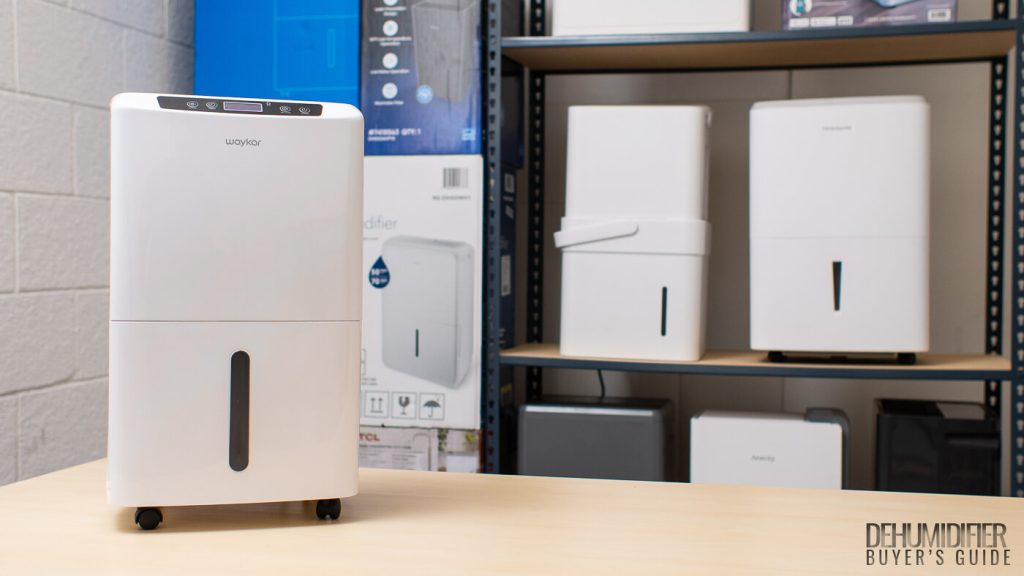
- Great portability – very light and small
- Excellent warranty – one year warranty can easily be extended to two years by registering your purchase with the manufacturer
- Terrible performer in our moisture removal test
- Poor energy efficiency
- Tiny water tank
- Dehumidifier
- Instruction Manual
| Energy Efficiency | 4.0 |
| Noise Output | 3.5 |
| Moisture Removal | 2.5 |
| Hygrometer Accuracy | 3.0 |
| Durability | 3.0 |
| Adjustability | 3.0 |
| Versatility | 3.5 |
| Extra Features | 4.5 |
| Ease of Use | 3.0 |
| Portability | 5.0 |
| Warranty | 5.0 |
| Value | 2.0 |
| Editor's Score | 3.6 |
Quick Note About Dehumidifier Capacity
The Waykar PD160B is marketed and sold as “34 pint” dehumidifier.
Note though, that it only removes 34 pints of moisture per day at extreme temperature and humidity levels – at 95°F, 90% RH.
It removes only 10 pints/day at 65°F, 60% RH (standard US DOE levels).
So, despite its marketing, the PD160B is a very small low capacity (albeit still compressor based) dehumidifier.
Performance Test Results
Energy Efficiency
The PD160B was measured to draw only 119 watts of power at approx. 50% RH. This is very low power draw even for a small dehumidifier.
The problem, when it comes to energy efficiency is that it takes very long to lower room humidity.
The PD160B was measured to draw about half as much power as the small Midea Cube (MAD20S1QWT), for example, but it took about six times longer than the small Cube to lower room humidity in our moisture removal testing (we’ll talk more about this test in just a bit).
The bottom line – the PD160B has very poor energy efficiency compared to top rated dehumidifiers we recommend (like the small Cube).
Noise Output
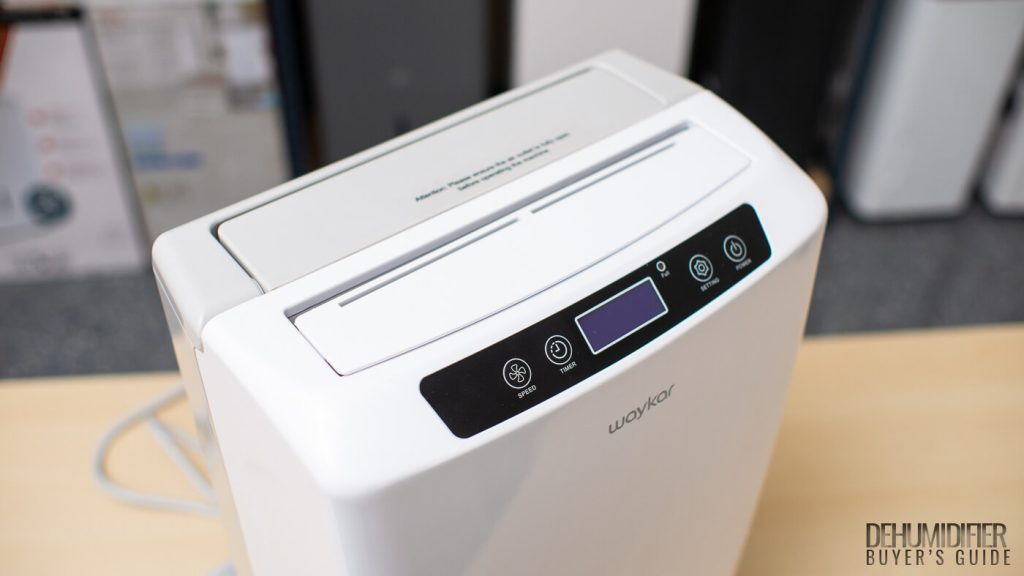
The PD160B is the quietest compressor based dehumidifier we’ve tested so far.
It was measured at only 59.1 dB on high fan speed (right above and to the front of its control panel) and 53.9 dB on low fan speed.
Most other small dehumidifiers we tested were measured to produce at least 60 to 65 dB of noise on high and 58 to 62 dB on low.
Buzzing compressor noise for the PD160B is prominent on low fan speed (like it is for most competitors) but mostly masked on high fan speed.
In other words, it makes sufficient fan noise (which is more pleasant sounding) to properly mask compressor noise (which is much less pleasant sounding) on high fan speed. Not so much on low fan speed. Though this is the case for most competitors as well.
One extra caveat for the PD160B – there is a strange “swooshing” sound as air passes past the louvre on the top of the dehumidifier. We didn’t really hear this type of noise with competitors. It’s a much more consistent fan noise that emits from the exhaust of most competitors.
Moisture Removal
The PD160B was a terrible performer in our moisture removal testing.
In the first test we measure how long it takes the dehumidifier to lower room humidity from 90% down to 40% RH (Relative Humidity) in a 50 sq. ft. room. And it took the Waykar approx. 1 hour, 20 minutes to do so in this test.
For comparison, it took the top rated small Cube only 13 minutes, 25 seconds to do the same in the same test. It took another small dehumidifier example, the Aeocky RHEA-001, only 14 minutes, 9 seconds.
You can see how the Waykar’s time is clearly an outlier. It did not perform well in this test at all.
In the second test we measure how long it takes the dehumidifier to lower room humidity from 80% down to 50% RH. This is a much easier test. And in this test the Waykar also performed poorly.
It took 37 minutes, 45 seconds in this second test. It took the small Cube just under 7 minutes. It took the Aeocky just under 8 minutes – in the same test under the exact same conditions.
The bottom line – the PD160B will still remove moisture faster than most cheap thermoelectric dehumidifiers under $100, but it removes moisture significantly slower than most small compressor based dehumidifiers (like the small Midea Cube, which is priced very similarly to the PD160B).
Hygrometer Accuracy
The PD160B does display current room humidity. This reading was consistently about 5% higher than the actual room humidity though in our testing.
Included Features, Functionality, Build Quality, Warranties, and Value
Durability (Build Quality)
General Impressions
The PD160B is better built with higher quality parts than cheap dehumidifiers (in the sub $100 range) but it is definitely not as well built and it’s definitely built using lower quality parts than top rated small dehumidifiers we recommend (like the small Midea Cube).
Consumer Feedback
Consumer feedback for this model is mostly positive. That being said, there is a sizable chunk of reviews that complain about its build quality.
Overall Category Score
Overall, this model scores only a 3/5 for durability. Again, it does have better build quality than cheaper competitors, but it has significantly worse build quality than top rated competitors at the same approx. price point.
Adjustability
This model has two fan speeds but no continuous mode and no automatic modes.
Overall Category Score
It scores only a 3/5 for adjustability.
Versatility
Set Humidity Range
You can set the PD160B to a target humidity level of 30% to 80% RH.
Operating Temperature Range
This model’s recommended operating temperature range is 41° to 95° F (standard for a compressor based dehumidifier).
Gravity Drainage
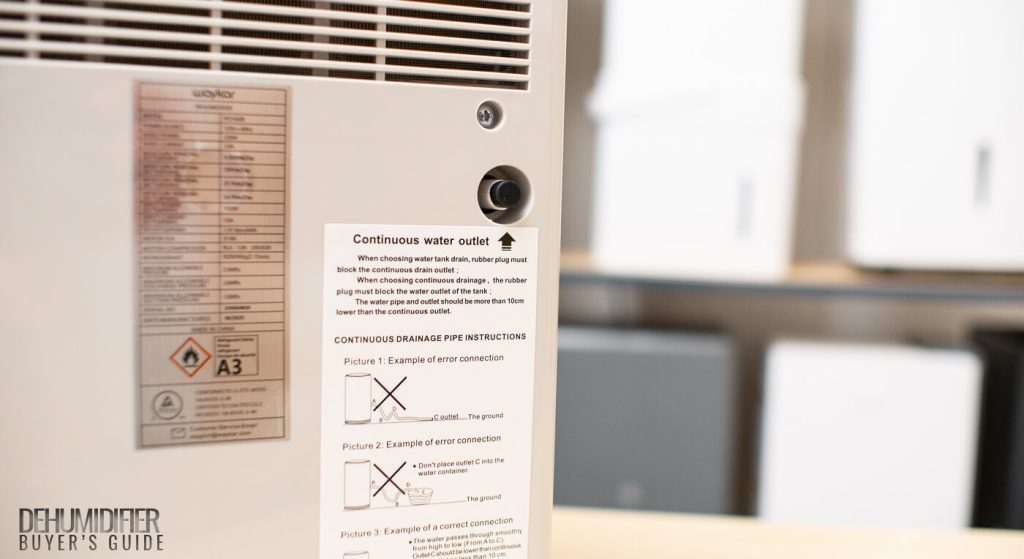
You can drain this unit though a gravity drain outlet on the back of the dehumidifier, but to do so you have to first press an included rubber plug into the “water tank draining outlet” behind the water tank in the front of the dehumidifier.
So, this process (setting up the dehumidifier for gravity drainage) involves an extra (very easy to lose) part and step that you don’t have to take with most competitors.
Built-in Pump
This dehumidifier does not have a built-in pump.
Overall Category Score
Overall, the PD160B scores only a 3.5/5 for versatility.
Extra Features
Temperature Reading
The PD160B is one of very few dehumidifiers that we’ve tested that displays room temperature. You can also toggle the display between degrees Celsius and degrees Fahrenheit.
Defrost
Like most other compressor based dehumidifiers, the PD160B does have a defrost mode that’s automatically activated if ice builds up on its evaporator coil.
On this mode, the dehumidifier will cycle off its compressor and only run its fan to melt the ice.
Check Filter
This model does not a have a check filter light (to alert you when it’s time to clean its air filter).
Overall Category Score
Overall, the PD160B scores a 4.5/5 for extra features.
Ease of Use
Setup Difficulty
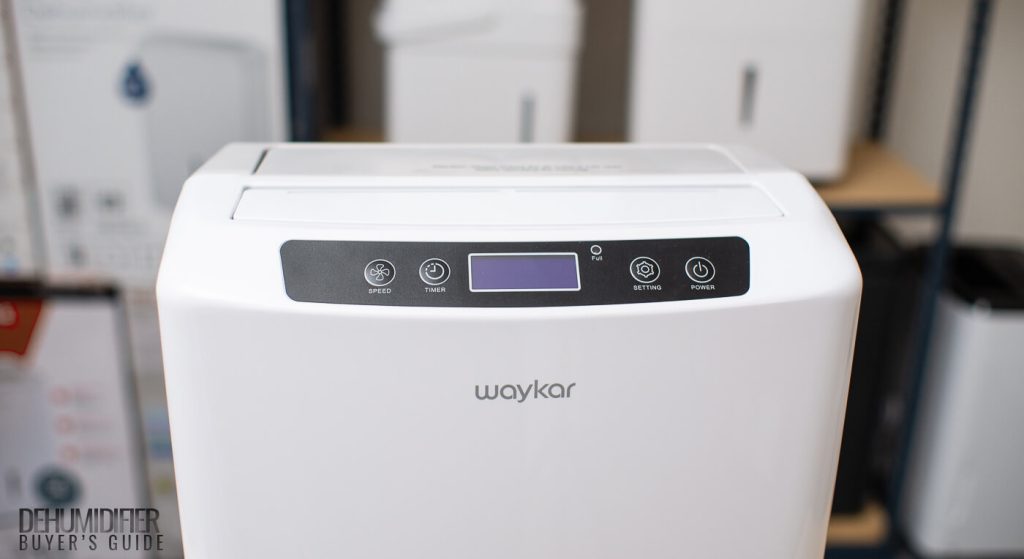
The fan indicator on this unit’s control panel is terrible – it spins fast on high fan speed and it spins slowly on low fan speed. But there’s no way to identify whether it’s spinning fast or slow without first pressing the fan speed button multiple times to toggle between the two speeds.
Setting a target humidity level on this dehumidifier is also not a pleasant experience. You have to press the ambiguous “setting” button repeatedly to toggle this level and doing so only moves the level in one direction. So if the dehumidifier is set to 50% and you want to set it to 45% you can’t press a button to quickly lower the humidity level (i.e. the minus (-) button on most competitors). You have to press the setting button repeatedly to cycle through the upper end of the range before it resets to the lower end of the range.
Filter Removal Difficulty
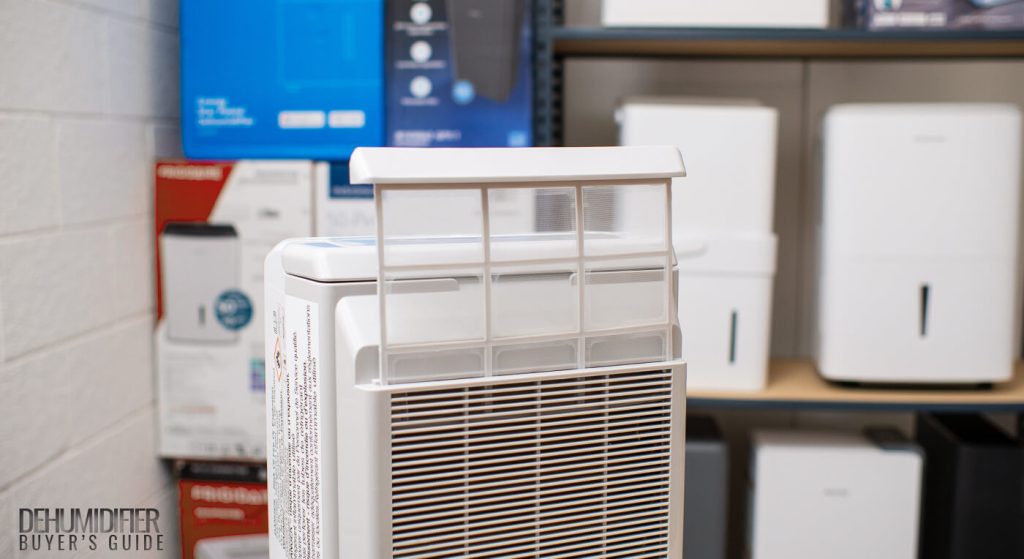
We didn’t have any trouble removing or replacing this unit’s air filter.
Manual Clarity
We have no complaints about the included user manual.
Water Tank Size
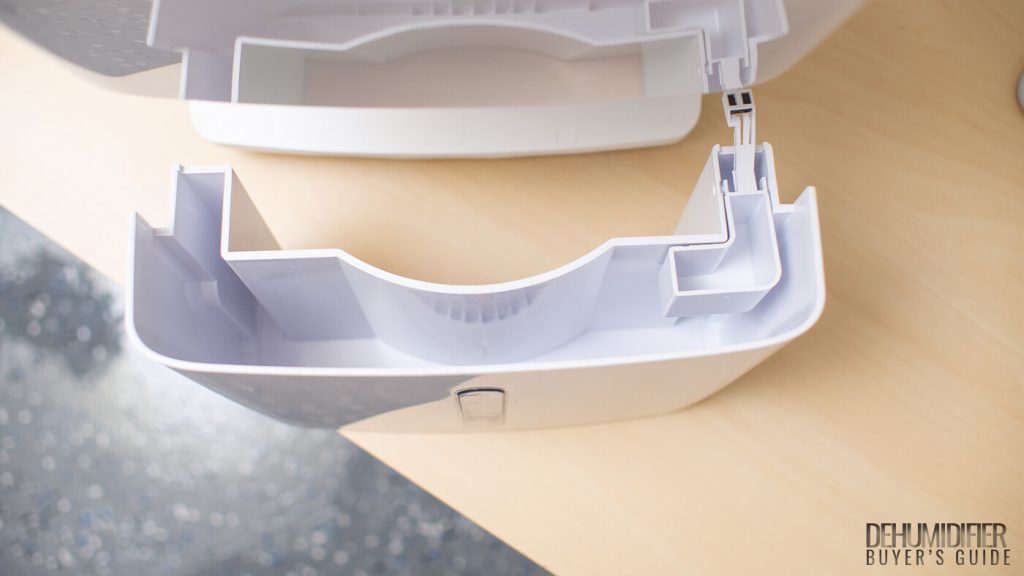
This dehumidifier’s tank is tiny – it only has a capacity of 5.3 pints. Most other small compressor based units we tested have a tank with a capacity of at least 8 to 10 pints.
On the positive side of things, the PD160B removes moisture very slowly, so it doesn’t really need as large of a tank as most competitors.
A few more negatives – after removing the water tank, water would always keep dripping into the compartment behind the tank during testing.
It was also tricky to reinstall the tank after removal. We had some trouble with the float getting stuck when trying to reinstall the tank.
Overall Category Score
Overall, this model scores only a 3/5 for ease of use.
Portability
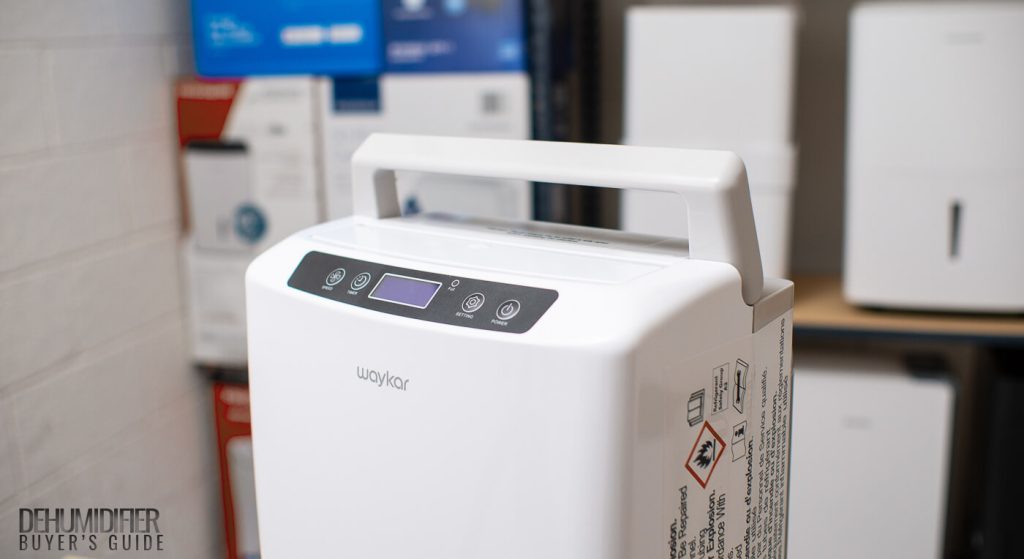
The PD160B is very light and small, even compared to most other small dehumidifiers we’ve tested. It also has a top handle and casters.
Overall Category Score
Overall, it scores a 5/5 for portability.
Warranty (Manufacturer’s)
This model comes with a one year warranty and you can extend it to two years if you register your purchase with the manufacturer.
Most competitors also come with a one year warranty but you cannot extend their warranties for free like you can with the PD160B.
Value
The PD160B is usually priced similarly to the top rated small Midea Cube – in the $150 to $200 range. Compared to the Cube, it’s a terrible value. Why? Because it takes six times as long to dehumidify (according to our testing), it’s much less energy efficient, it has much worse build quality, and it has a much smaller water tank.
If you’re looking for a more affordable small dehumidifier we highly recommend the Cube over the PD160B.
The PD160B, with a moisture removal rate of 10 pints/day (at 65°F, 60% RH) should be half the price of the 20 pints/day Cube.

Have a question or comment? Let us know below.